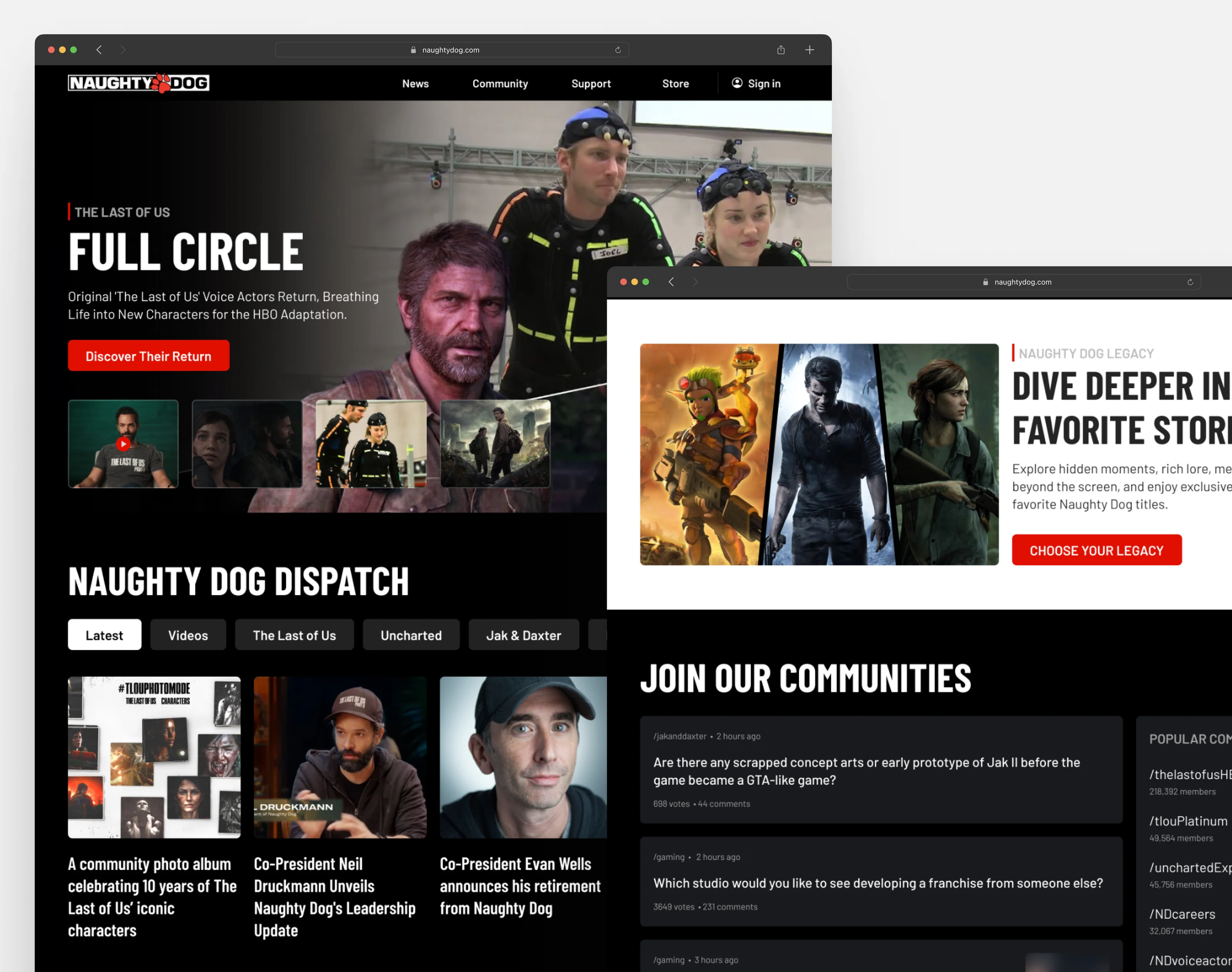
Universes Beyond the Console
Naughty Dog's fans had already built the platform the studio was missing, on someone else's site.
TLDR
HBO's The Last of Us sent a new audience looking for more of the story, and Naughty Dog's site had almost nothing to give them. I benchmarked the site, surveyed 150 fans and interviewed 65 to find out where they were going instead, and why. The result is a redesign that turns the studio site from a signpost into a home for its worlds, bringing the lore, community and news that fans had built elsewhere back to Naughty Dog.
The Front Door
The show created a new audience. The studio had nowhere to put it.
In early 2023, HBO's The Last of Us sent a new audience looking for more of a story Naughty Dog had been telling for a decade. Many went straight to the source. In the UK, sales of The Last of Us Part I rose 238% week on week after the premiere, and the older Remastered edition rose 322%.
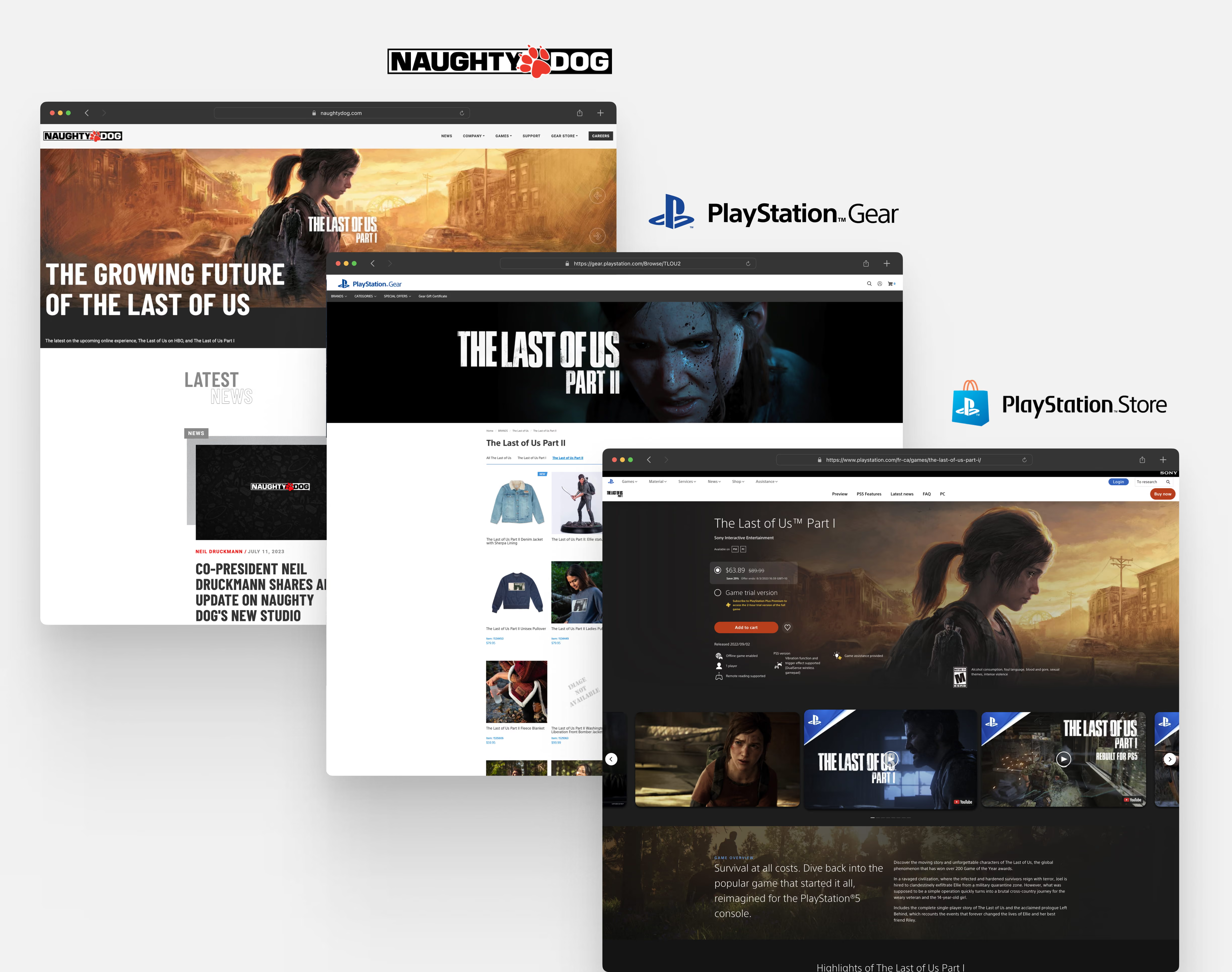
Naughty Dog's own website had almost nothing to give them. It had two audiences to serve: fans like me who had followed the studio since Crash Bandicoot, and viewers meeting its worlds for the first time. It served neither, so both went elsewhere, and the studio wasn't part of it.
The Case for Doing Nothing
There was a credible reason to leave the site alone. I bet against it.
"The last of us" drew 2.2 million searches a month in the US, and naughtydog.com ranked 12th. Visitors who did arrive stayed for 47 seconds, and 60% left after one page. There's a defensible reason for that. Naughty Dog is a PlayStation studio, and its game pages link straight to the PlayStation Store. If the goal is units sold, the studio's own site barely matters.
That reasoning breaks down if the goal is a lasting relationship with players. Sales peak at launch, but a relationship has to survive the years between releases, and Naughty Dog hadn't shipped a new game since 2020. I designed for the relationship and treated it as a bet, not a finding. From outside the studio, I couldn't see its analytics, budget, or terms with Sony and HBO. The rest of the work had to earn the bet.
Knowing the Terrain
Studio websites all fall short in the same way. The benchmark worth chasing wasn't another studio.
I benchmarked naughtydog.com against two studios, Insomniac and Telltale, and one franchise destination, Wizarding World. The three studio sites were almost identical: visits of around a minute, with more than 60% of visitors leaving after one page. They work as signposts, pointing to a store, a job board or a Discord server somewhere else.
Wizarding World treats the universe itself as the product. Visitors stay nearly seven minutes, view eight pages, and only a third leave after one. Harry Potter has a different audience, so the numbers aren't directly comparable. But they changed the question from "how do we build a better studio site?" to "what would Naughty Dog's worlds look like as destinations?"
Benchmark · SimilarWeb, August 2023
| Site | Avg. visit | Bounce |
|---|---|---|
 Naughty Dog Naughty Dog | 60% | |
 Insomniac Insomniac | 64% | |
 Telltale Telltale | 64% | |
 Wizarding World Wizarding World | 33% |
Three studio sites, one pattern. The franchise destination keeps people nearly nine times longer.
Straight from the Source
A survey measures what fans want. Interviews explain why.
I built four proto-personas around why people come rather than who they are: the Lore Master, the Cinematic Enthusiast, the Social Connector and the Strategy Seeker. They set the recruitment quotas, so the research wasn't dominated by the most online fans, who were never the problem.
I surveyed 150 people, from casual players to long-time fans, to see how widely a need was shared. I interviewed 65 to understand why, meeting them where they already talked: one-on-one calls, group sessions, Discord servers and DMs.
There’s little reason to visit these websites when alternative sites provide comprehensive information, like guides, news, features and mechanics.
What the Fans Were Already Doing
The gap wasn't information. Fans had built what was missing themselves, on someone else's platform.
82% of survey respondents wanted deeper lore, and 59% wanted proper character profiles. In the interviews, 86% saw little value in the current site, three in four were already finding that content elsewhere, and 53 of 65 would rather have it in one place.
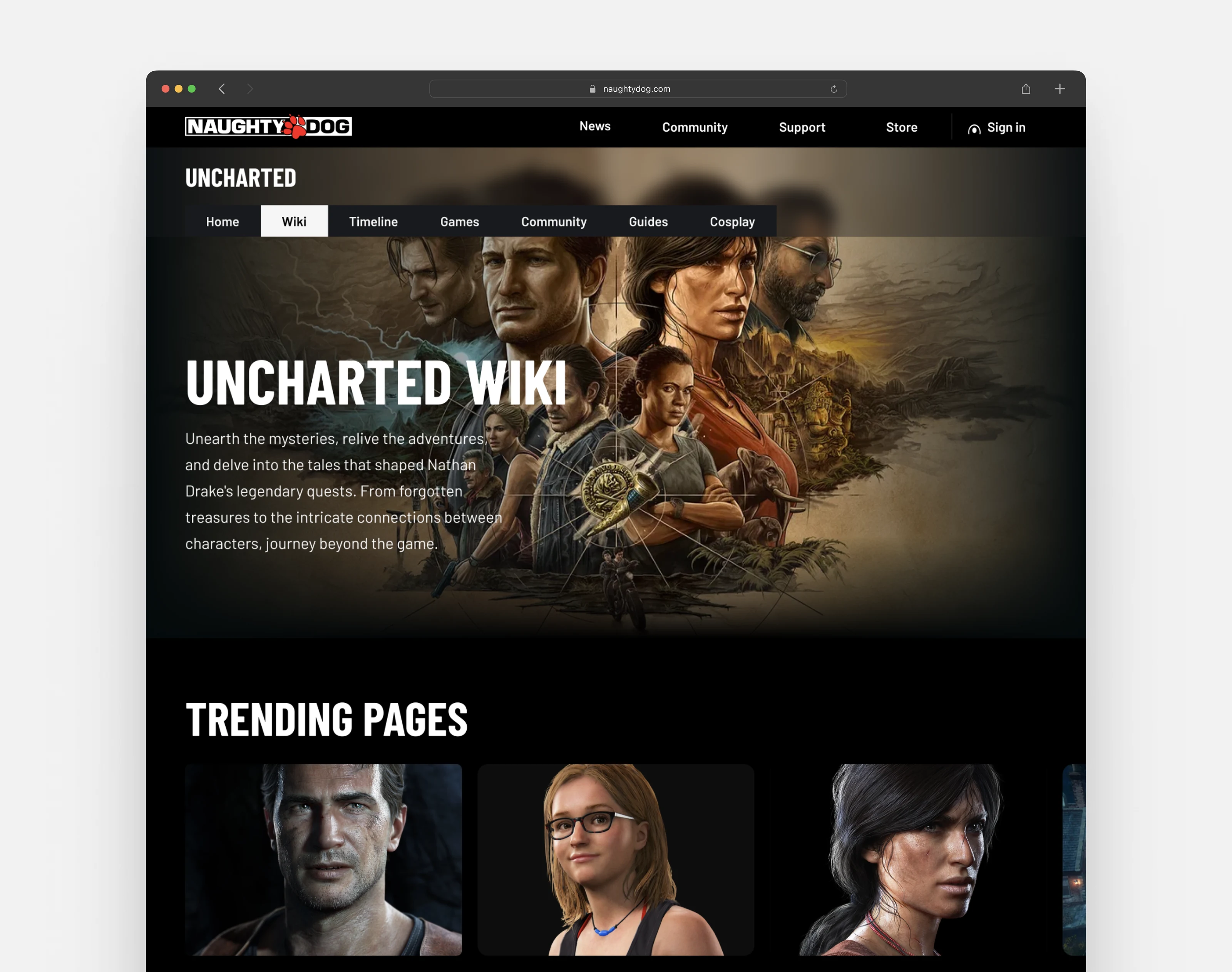
Fans had already written the wikis, charted the timelines and worked out the cosplay patterns, on fan wikis, subreddits and YouTube channels funded by someone else's ads. The universes had a thriving second life, and Naughty Dog wasn't part of it.
Platinum guides and more lore about the games. I want to be more involved in the universe my favourite games are in.
Ceding the News Cycle
Some battles aren't worth fighting. News was the easiest to give up.
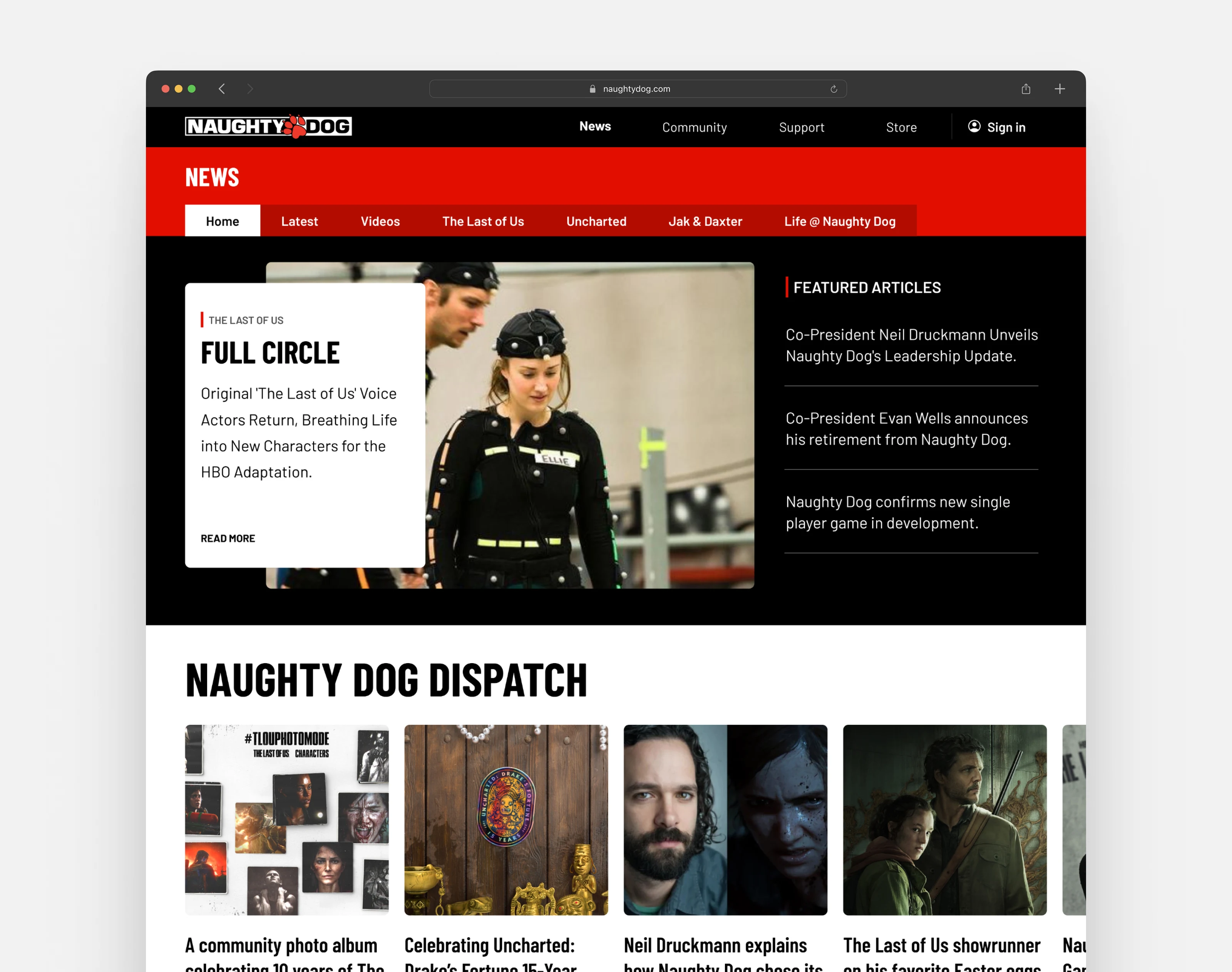
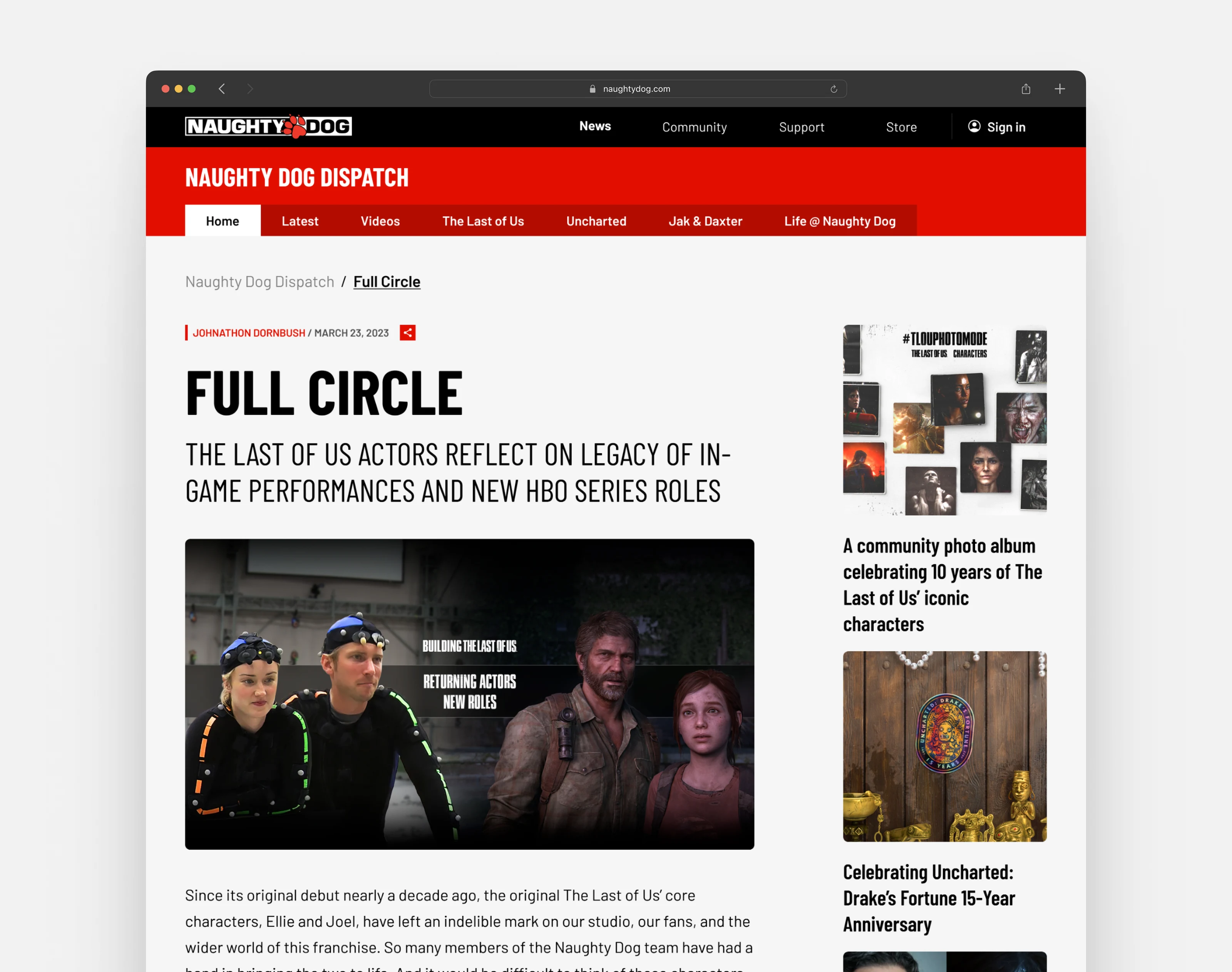
GameSpot, Kotaku and countless YouTube creators cover every announcement faster than a studio can. A content audit showed the blog was already drifting away from news: half its recent articles were material only the studio could publish, like community Photo Mode collections and the cast reflecting on bringing Ellie and Joel to the show.
So news became Naughty Dog Dispatch: behind-the-scenes footage, developer updates and releases straight from the studio. Nobody else has access to this material, so nobody else can beat the studio to it.
The Business Case
Fans get depth. The studio wins back an audience that other platforms currently profit from.
I framed the business case as three hypotheses the studio could check from inside.
Search. Fan wikis collected the franchise traffic the studio wasn't ranking for, and sold ads against it. Owning the universe content should win it back.
Relationship. Today the only reasons to return are a job board and a support desk. Accounts, forums and Dispatch give the studio a direct line to players between releases, and first-party data of its own.
Commerce. Merchandise sits on a separate PlayStation store, disconnected from the stories that make people want it. Putting products inside the worlds connects the two.
The strongest argument was timing. PlayStation Productions had released four adaptations in 18 months, two of them from Naughty Dog games. Every adaptation sends a new audience looking for the source. Without a destination, each wave ends up on someone else's platform.
The Universe Template
One system, filled by each world. Deep inside each title, open between them.
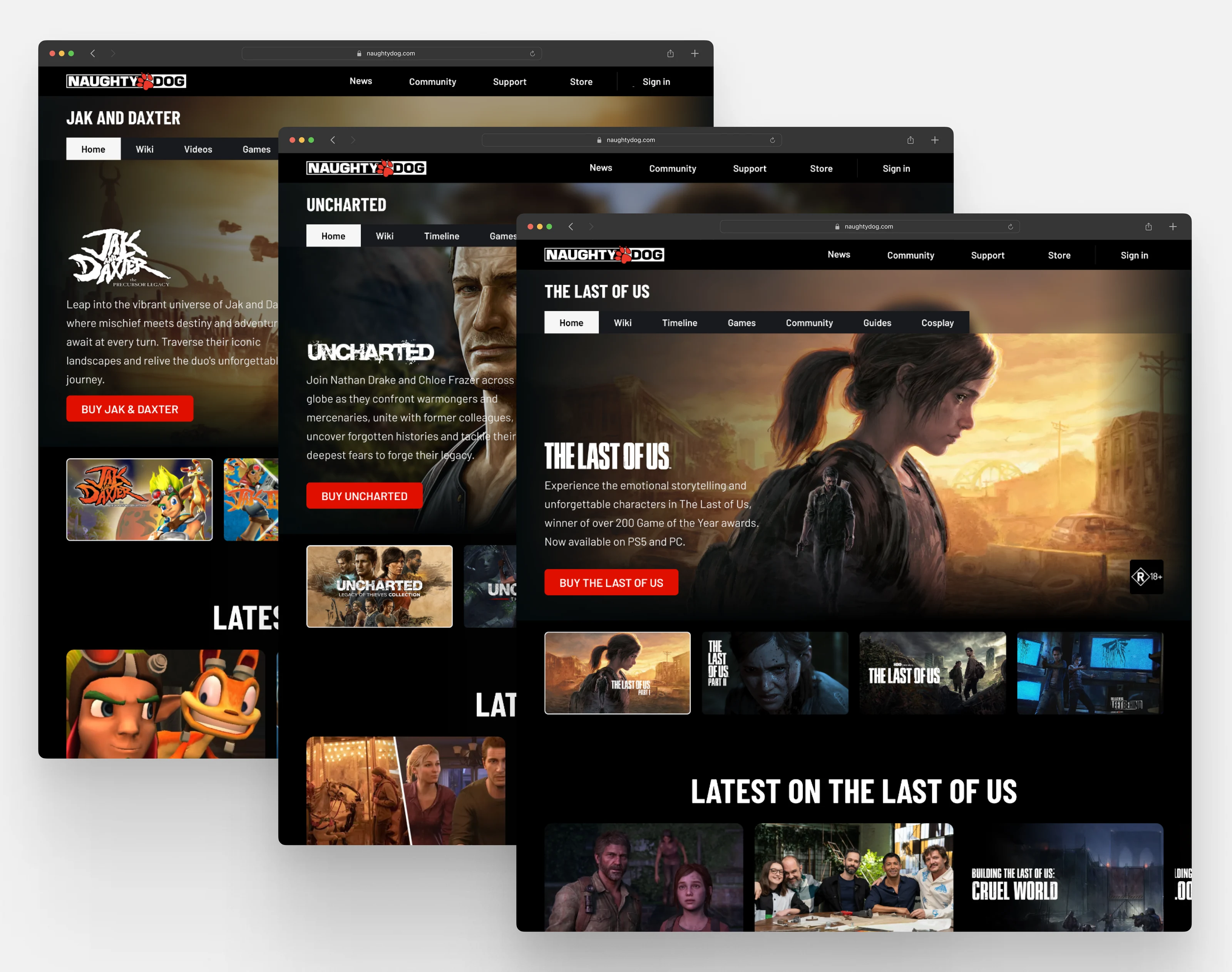
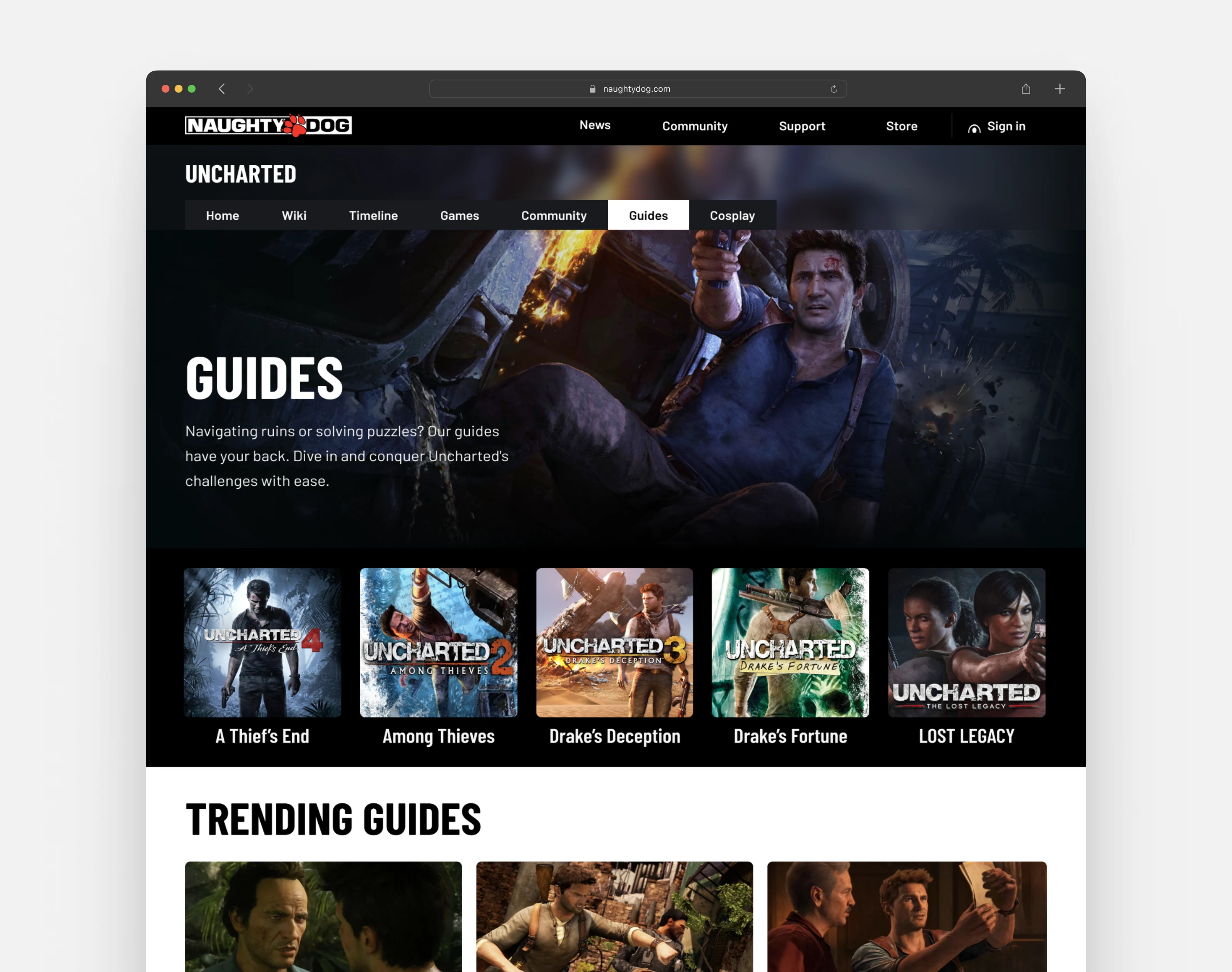
Every title gets a home built from the same parts and filled with its own world. That lets the studio open a new universe, or revive a dormant one like Jak & Daxter, by adding content instead of commissioning a new site.
Communities form inside a single fandom, so each title has its own official forum, with fan-run spaces growing beneath it. Moderating everything kills what's worth having, and moderating nothing eventually puts the licence at risk. Curiosity pulls people across titles, so the links between worlds live in the content, and newcomers from the show get their own way in. Telltale runs its own forums and still performs like a signpost. Forums alone don't hold people; worlds worth exploring do.
Worth the Weight
Spend the craft where it changes behaviour, not everywhere.
Arriving and buying are usually the most forgettable moments on a studio site, so that's where the 3D work went. The Legacy entrance presents each world as a sculpted figure, so picking a universe feels like a choice rather than a menu click. In the store, you explore Sarah's bedroom or Nathan Drake's attic instead of a product grid. You buy the Firefly pendant because you remember the story behind it.
WebGL is expensive and heavy, and the existing site already scored 31 for mobile performance. So the 3D layer is an addition, never a requirement: everything can be reached through the standard pages.
Testing Grounds
The design worked. Whether people want it was proven earlier, not here.
I tested the prototype with 30 participants from the research pool. 26 found it intuitive and engaging, 24 said they'd come back for the content, and 28 wanted to explore the 3D worlds further.
People who told me what was missing were always likely to respond well to being given it. The results show the design works for the audience it was built for. On their own they don't prove demand, which is what the research was for.
What It Would Take
The design is the cheap part. Keeping the worlds alive is the real cost.
The biggest ongoing cost is content. Wikis need writers and forums need moderators long after launch, and the fans who already maintain these resources are the obvious partners. Selling on the site also has to coexist with PlayStation's own stores, and anything drawn from the show depends on HBO's terms.
So I'd release it in three phases, each one earning the next: The Last of Us and Dispatch first, where the audience is already arriving; then the template across Uncharted and Jak & Daxter, with communities; then the 3D entrance and store, once there's traffic worth converting. Each hypothesis gets a number to track, starting from a 47-second baseline against Wizarding World's seven minutes.
After the Credits
The universe doesn't have to end at the console.
Most studios with a world worth caring about have the same empty room. The material already exists: fans have assembled it, other platforms host it, and someone else's ads pay for it. Bringing it home is less a content problem than a decision about who the universe belongs to between releases.
If I ran this again, I'd test with viewers who knew the show but had never played the games. They're the audience this was built to welcome, and the one I heard from least.